In the pot
₹3.6L
of ₹25L for a home
Apr 2027
Each coin is a month of ₹24,500.
ClickTap · hold to pour · drag to shake
Typical growth · 7.7% a year
Concept 01 / 04 · Product thinking · Fintech
Compass
A plan you can say yes to.
At a glance
- Role
- Sole designer
- Team
- Solo
- Development
- Design only, no build
- Scope
- Your plan screen and the adjust flow
- Platform
- Mobile
- Status
- Concept, revised after a design review
In one sentence
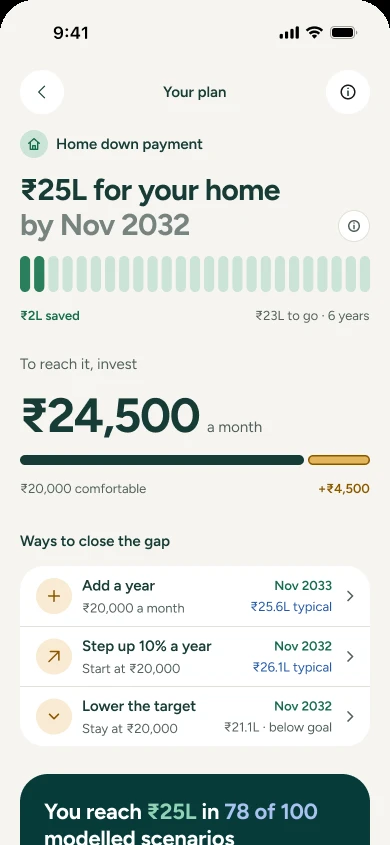
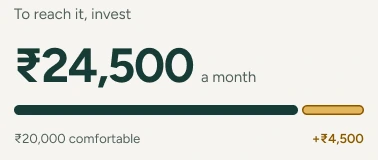
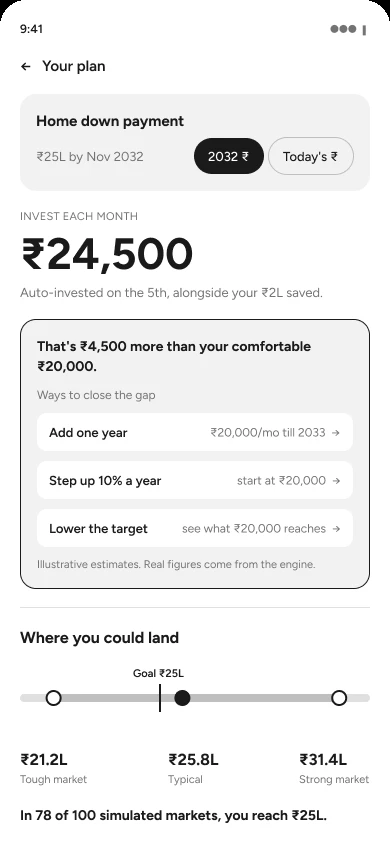
Compass turns a goal into a monthly plan, like ₹25L for a home by Nov 2032. The sample plan asked for ₹24,500 a month from someone comfortable with ₹20,000 (opens chapter 03 · Who it’s for). I designed a plan that says so up front (opens chapter 01 · The real problem), shows a range instead of one promise (opens chapter 02 · The numbers), and lets her close the gap without starting over (opens chapter 06 · Plan and adjust).
Every underlined part jumps to its chapterTap an underlined part to jump to its chapter
Read time · 4 min
01The real problem
Compass · the brief
The plan was right on paper and wrong for her.
The brief came with a sample plan for a first home: ₹25L by Nov 2032, ₹2L already saved, ₹24,500 a month. Every number checked out. Read closely, it asked for more than she was comfortable giving, spoke in 2032 rupees, and kept its best news at the bottom.
The plan · as given
₹25L for a home by Nov 2032.
- 01₹4,500 more than she’s comfortable with (opens chapter 06 · Plan and adjust)
- 02₹25L means 2032 rupees (opens chapter 02 · The numbers)
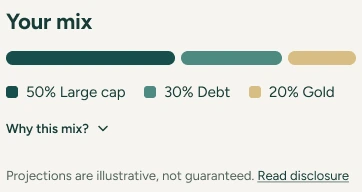
- 03“Conservative”, half in equity (opens chapter 03 · Who it’s for)
Drag the switch to Yes · tap a reason to jump to the chapter that fixes it
Where this goes · chapter 06
02The numbers
Compass · the math
I did the sums before I drew a screen.
Before any layout, I worked the sample plan through line by line, with AI checking my arithmetic. Four results decided what the screen leads with, what it names out loud and what it keeps one tap away.
The sums · printed as you scroll
- 24,500×
- 72=
- 17,64,000
- 2,00,000+
- 21,20,000Tough case
- 24,500−
- 20,000=
- 25,00,000÷ 1.06⁶
Became, on the screen
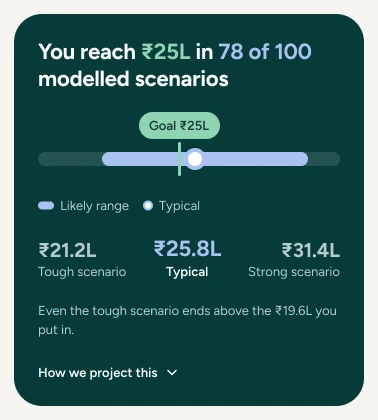

“Even the tough scenario ends above the ₹19.6L you put in.”
The reassurance moved from the bottom of the brief into the card itself, in her words and in rupees.
Scroll · the tape prints line by line. Click a total · the screen shows what it became.Scroll · the tape prints line by line. Tap a total · the screen shows what it became.
03Who it’s for
Compass · people from the brief
Designed for Priya. Rohit gets a layer, not a flow.
The brief came with two people. Priya, 28, saves ₹20,000 a month in an FD and wants ₹25L for a home. Rohit, 34, already invests ₹40,000 a month and wants the why behind everything. Every figure in the brief is Priya’s, so the screen is hers. Rohit’s questions live one tap deeper.
Primary · first time investor
Priya, 28
- Saves ₹20,000 a month in an FD
- Wants ₹25L for a home in 6 years
- Scared of losing money
- Wants to be told what to do
What she sees first
The answer, the amount, the gap and the chance. Nothing she has to decode.
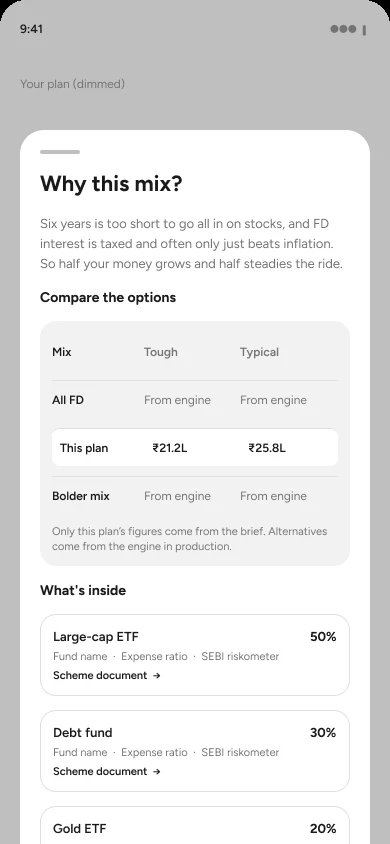
One tap deeper · Why this mix?
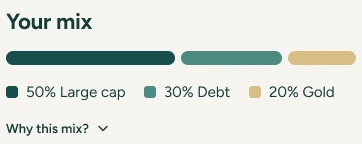
- The reasoning
- The alternatives
- Fund detail
Flip the switch · the screen sinks and Rohit’s layer slides up over it. Priya never has to open it.
04Principles
Compass · the rules
Five principles. Each one rules something out.
Before drawing anything, I wrote five rules for the screen. Each one says yes to something and no to something else, and three of them trace straight back to a moment where Priya might walk away.
Where she might walk away
Principle
On the screen
Five rules · and the moment each answers
01 and 05 hold everywhere
Hover a walk away moment · its thread lights up to the rule and the piece of screen that answers it.Tap a rule · it opens to the piece of screen it made. 01 and 05 hold everywhere.
05The flow
Compass · wireframes
From a goal to a plan she trusts.
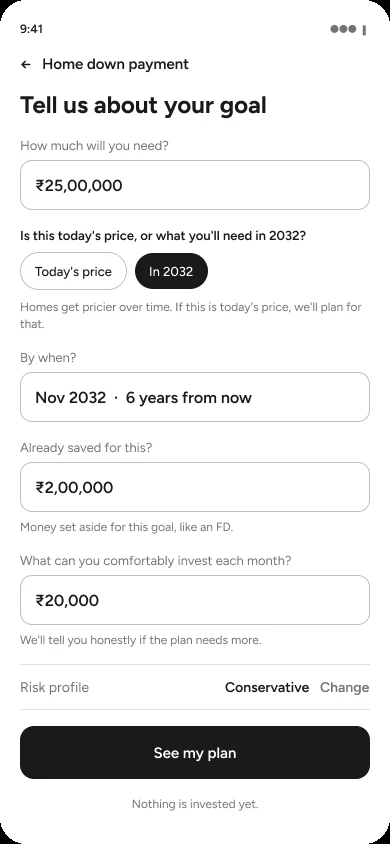
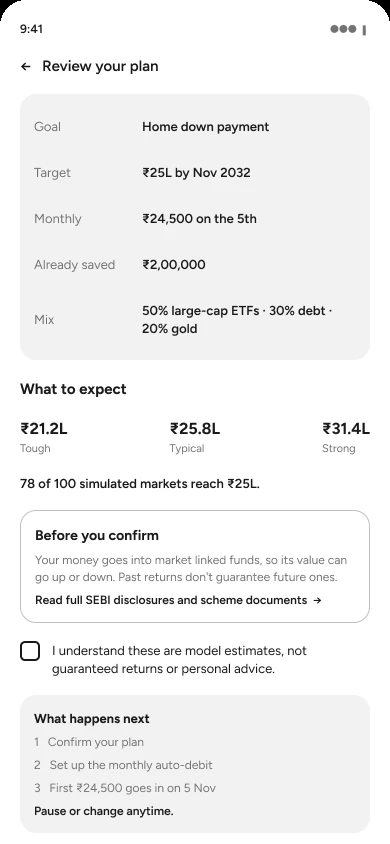
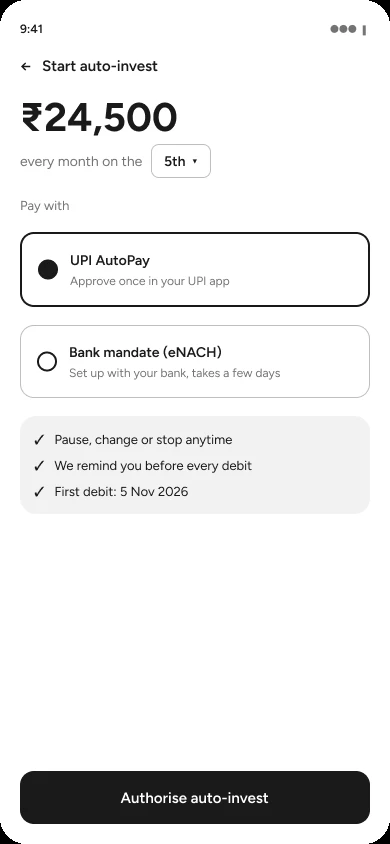
Six screens and one sheet, in three acts: set up the goal, earn her trust, then commit. Greyscale on purpose, structure and words first. Saying yes to the plan and moving money are two separate steps, so yes stays cheap for a nervous first timer.
 01
 02
 03
 04
 05
 06a
 06b
 07
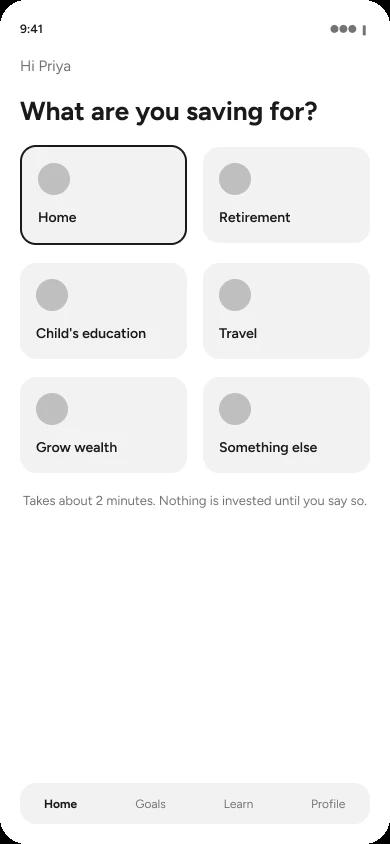
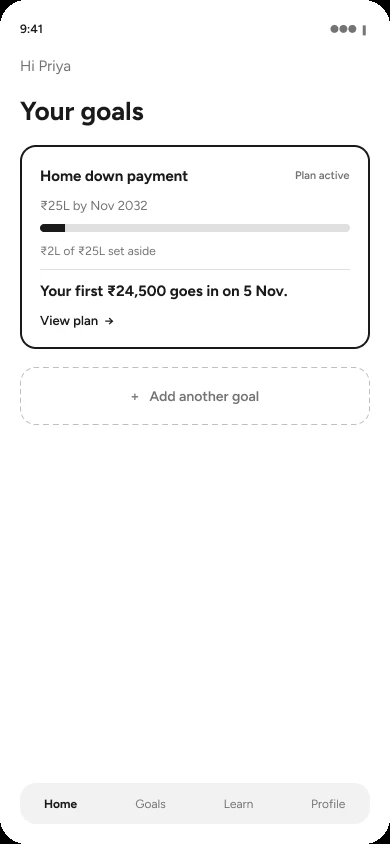
01 · Empty home
A question, not a dashboard. No ₹0 balances or empty charts: her life first, products second.
Drag the strip or scroll · the screen in the middle grows and its note changes.Swipe the strip or scroll · the screen in the middle grows and its note changes.
06Plan and adjust
Compass · high fidelity
Two screens, one calm decision.
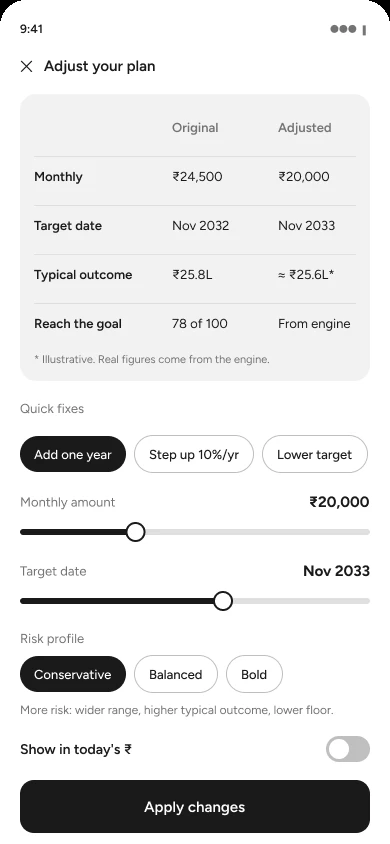
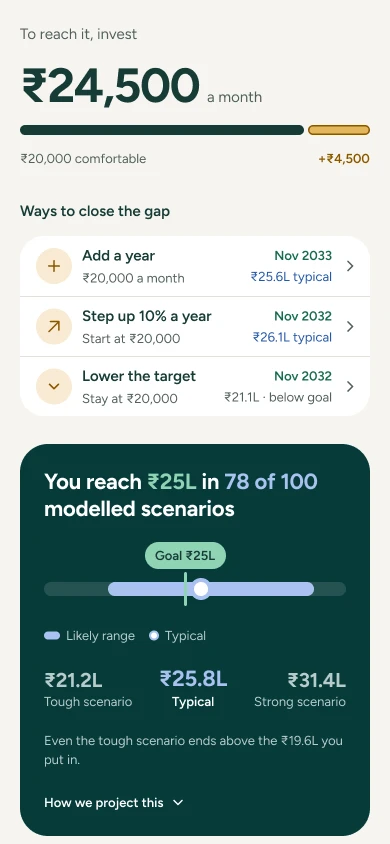
Your plan tells one story: the goal, what it takes, where she could land, then go. Adjust is where she shapes it to her life. Every colour means one thing, and nothing changes until she applies.
Your plan
Adjust · Add a year applied
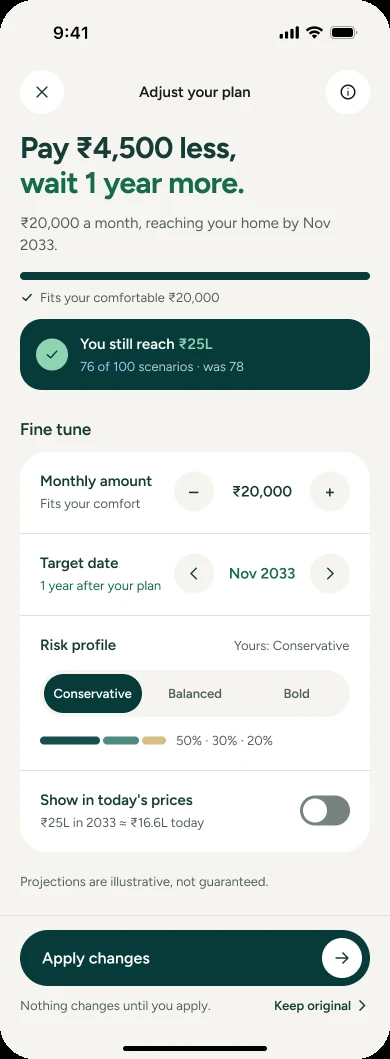
Tap a way to close the gap · Adjust slides in with that change already applied. Keep original · it slides back.Tap Add a year · Adjust slides in with it applied. Keep original · it slides back.
07After the review
Compass · version two
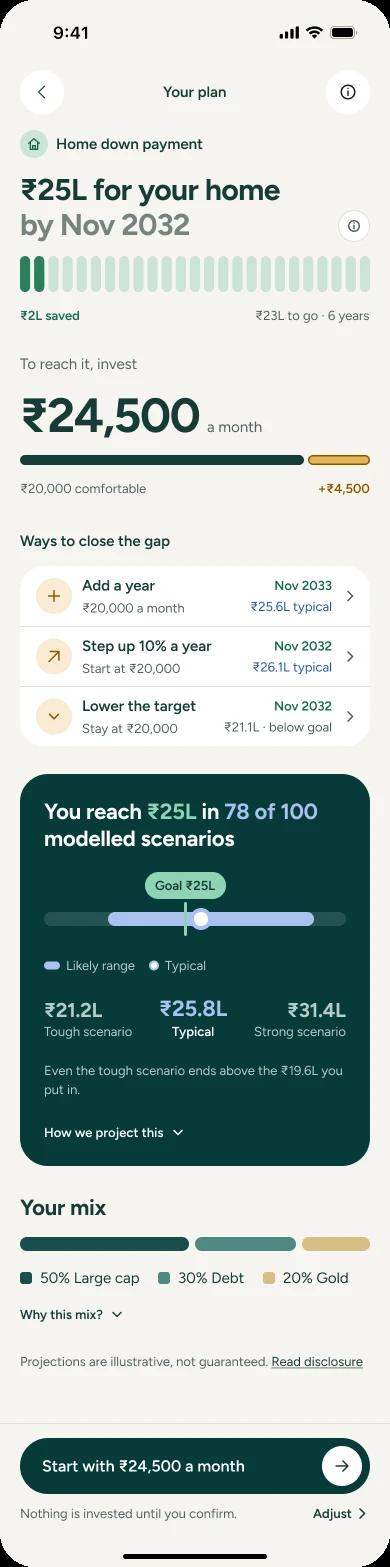
The second version tells one story.
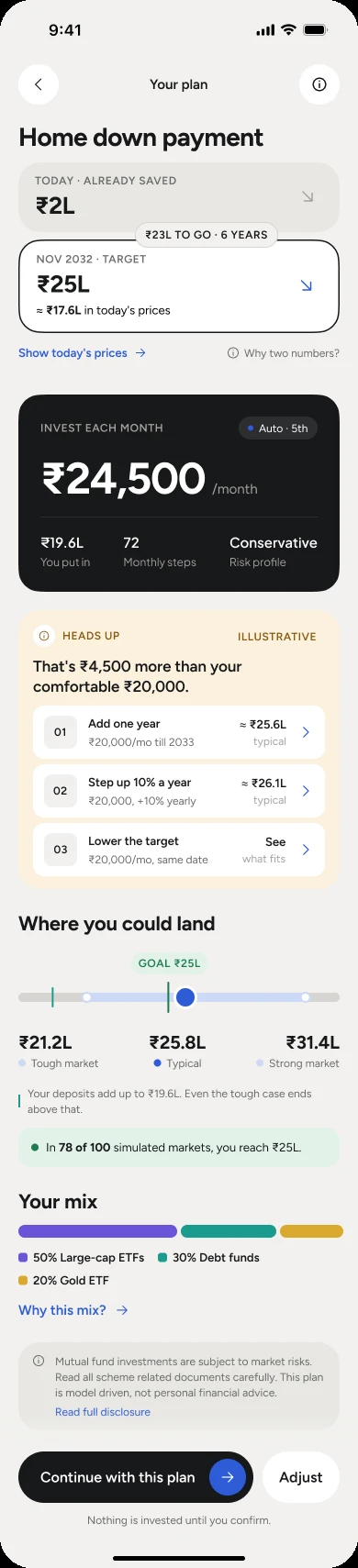
A design review came back with ten notes on the first version, then a second round on three palette options. Every note led to a change. Colour got one meaning each, the text got cut, one dark card leads, and the mono labels made way for Figtree.
Version one
Version two
05 · Condense the top
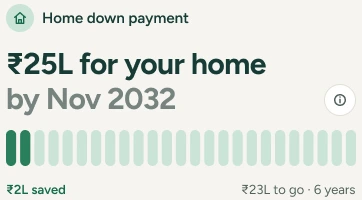
Saved, target and to go were three blocks and a “Why two numbers?” link. They became one goal summary with 25 pills, one per lakh. Today’s money moved behind an info button.
Every note, one change
Scroll · both versions scroll together. Markers pair the before and after of each note. Pick a note to jump to it.Scroll · both versions scroll together. Markers pair the before and after of each note. Tap a note to jump to it.
08How I’d know
Compass · tests and signals
Every risky trade off becomes a test.
This is a plan for testing, not results. If Compass built it, these are the four questions I would answer first, and the numbers that would tell me it worked, or that it went wrong.
Test 02 · try it on yourself
In your own words, what does this card tell you?
The reading to watch for. If people retell the card this way, the floor line is promising too much, and its words change before anything ships.
That’s the reading the card is built for.
If people retell it this way, “78 of 100” isn’t landing as a chance, and the headline needs to say so more plainly.
The other three
- 01Does showing the ₹4,500 gap up front help, or scare people off before they see the plan?
- 03Does “Why this mix” satisfy a skeptic like Rohit?
- 04Is “today’s price vs 2032 price” understood on first read?
Pick an answer · the card says what that reading means for the copy.Tap an answer · the card says what that reading means for the copy.